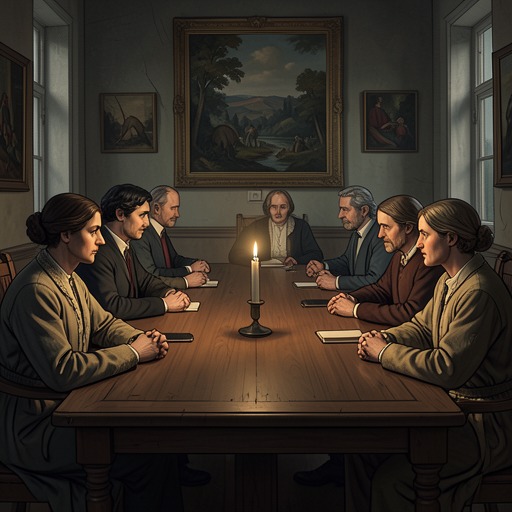
The Ramsays’ dinner and boeuf en daube feast
To the LighthouseThe Ramsays’ dinner and boeuf en daube feast is both a social occasion and one of the novel’s clearest demonstrations of how momentary harmony is made. Mrs Ramsay’s dinner begins under pressure: guests are late, the carefully timed stew may be spoiled, and she feels detached from the people she is expected to hold together. Yet the candlelit table, the arrival of Minta Doyle and Paul Rayley, and the pleasure of a successful meal gradually create a common world. Its unity is real but temporary, achieved through attention, food, and Mrs Ramsay’s sustaining labor rather than through any resolution of the differences among the guests.
Preparation and the delayed guests
The dinner matters especially to Mrs Ramsay because William Bankes has finally agreed to dine with the family, and because the principal dish, a French family recipe of boeuf en daube, has been prepared with unusual care. With fifteen people expected, the food must be served at precisely the right moment: the beef, bay leaf, and wine must be cooked to a turn. The meal therefore depends on timing as well as hospitality. When the party remains incomplete, she cannot simply let the carefully prepared dish wait without risk of spoiling it.
Her concern sharpens when Minta Doyle and Paul Rayley, who have been out together, fail to return on time. Mrs Ramsay is annoyed at their lateness, but the irritation is mixed with anxiety and the hope that something has happened between them. She also wants her children ready for dinner. Rose may choose the jewels she will wear, while Jasper and Rose help their mother prepare to go downstairs; the practical arrangements make the dinner a family performance as well as a meal. When the guests finally come back, Mrs Ramsay feels more annoyed than relieved, since the presence of others means they cannot tell her what occurred.
The dinner’s punctual demands are made visible in the kitchen crisis. Mrs Ramsay smells burning and fears that the boeuf en daube has been left to overboil. The gong then gathers people from separate rooms and activities: those reading, writing, dressing, or finishing their appearance must leave their private spaces and assemble at the table. The ceremony of dinner brings them together, but it does not immediately make them feel connected.
A divided table and a renewed effort
Taking her place at the head of the long table, Mrs Ramsay looks at its white plates and feels that her life has come to a standstill. Paul and Minta have their shared experience; she has the table, the knives, and the task of serving. Her husband sits at the far end, frowning, and she cannot recover the affection she once felt for him. As Charles Tansley and Augustus Carmichael join the others, the table presents itself not as a harmonious gathering but as a set of separate people.
Mrs Ramsay recognizes the work required to change that condition. In her perception, the room is shabby and has no beauty; the guests have not merged, and each remains isolated from the others. The effort of creating a shared occasion seems to rest on her alone. She nevertheless resumes the ordinary business of service, ladling the soup and attending to the guests, until her familiar sense of purpose begins to return. Pity for William Bankes, who has no wife or children and normally dines alone in lodgings, helps draw her back into the company. She asks whether he found his letters, making a specific gesture of welcome rather than announcing an abstract wish for unity.
The candles alter the room’s appearance and the social mood. Eight flames illuminate the length of the table and Rose’s arrangement of grapes, pears, a shell, and bananas. Mrs Ramsay sees the fruit as a rich, almost expansive world; Augustus Carmichael is absorbed by the same dish. Their ways of looking differ, but looking together briefly connects them. As the candles bring the faces closer and the windows turn the outside world into wavering reflections, the room seems ordered and solid against the fluid darkness beyond it. The guests feel themselves gathered in a hollow, sharing a common cause against that surrounding instability.
The arrival, the lost brooch, and the meal
Minta Doyle and Paul Rayley enter with a maid carrying a great dish, apologizing for being late. Minta has lost her grandmother’s brooch, and her distress as she sits beside Mr Ramsay draws out his chivalrous teasing: he asks how she could be so foolish as to scramble over the rocks wearing jewels. The mishap gives the delayed excursion a concrete consequence, while leaving Mrs Ramsay attentive to the possibility that the pair’s relationship has changed.
Paul later tells Mrs Ramsay that he and Minta went back to look for the brooch. She hears special significance in his use of the plural: it is the first time he has said “we” in recounting what they did together. As the cook removes the cover, the scent of olives, oil, and juice rises from the dish, which has taken three days to prepare. Mrs Ramsay chooses a particularly tender piece for William Bankes, directing her care through the meal’s details even as she reads the emotional meaning of the evening. The feast becomes a way of marking what may be the beginning of Paul and Minta’s engagement, at once treating their love as serious and viewing the lovers with affectionate, amused distance.
William Bankes praises the dish as a triumph: it is rich, tender, and perfectly cooked, an achievement he wonders at in the depths of the country. His admiration restores Mrs Ramsay’s sense of their affection and esteem. She explains that the recipe came from her grandmother and joins Bankes in contrasting French cookery with what they consider English wastefulness. Her pleasure in the discussion is not merely culinary. The successful dish has given the group something to share, and her lively conversation helps turn the meal into an occasion rather than a succession of private concerns.
The dinner’s fragile harmony
From Lily Briscoe’s perspective, Mrs Ramsay’s renewed animation has a compelling, even unsettling force. She seems able to draw people into the emotional arrangement she wants: Paul and Minta appear to be engaged, Bankes is again close to her, and the meal has become a celebration. Lily sees Mrs Ramsay’s warmth as both protective and commanding, a power that can gather others around a desired vision while leaving Lily herself conscious of her distance from the lovers’ glow.
Mrs Ramsay’s own sense of the moment is quieter. Looking at her husband, children, and friends eating together, she feels a deep security rise from their presence. It seems to hold them together without requiring speech. For a moment, the ordinary arrangement of dinner appears to contain something resistant to change: a coherence shining amid the fleeting and unstable. Mrs Ramsay recognizes this as one of the moments from which what endures is made. The scene does not promise that the family or its happiness will remain intact; its force comes precisely from finding a brief, perceptible unity within a life subject to loss and change.
The meal’s achievement is therefore neither simply domestic success nor permanent reconciliation. The table has not erased Mrs Ramsay’s alienation from her husband, the guests’ separateness, or the pressure placed on her to sustain the gathering. Instead, attention to shared objects and acts—the candlelight, the fruit, the carefully served stew, and Bankes’s praise—allows connection to take form for a time. The dinner makes harmony an event produced through labor and perception: fragile, provisional, and valuable because it cannot be assumed to last.